
A court built for close play
The compact hard surface keeps players near the action. Pressure arrives quickly, but support is rarely far away.

What Is Futsal?
Futsal is a five-a-side game played on a hard court with a smaller, low-bounce ball. Ten players share a space about the size of a basketball court, keeping every touch, run, and decision close to the action.
At first glance, it can look like chaos. Watch a little longer, and the board reveals itself: passing angles open and close, attacks become defenses in an instant, and every touch changes what happens next. It is improvisation built on awareness, precision, and connection—chess played at full speed.

How Futsal Was Shaped
Futsal was shaped for indoor spaces. Its court is similar in scale to a basketball court, and its goals use the same 3-meter-by-2-meter dimensions found in handball. A lower-bounce ball, five-player teams, on-the-fly substitutions, and four-second restarts all serve a fast game played in limited space.
Together, those elements create a game that stays close, moves quickly, and continually involves every player.
The compact hard surface keeps players near the action. Pressure arrives quickly, but support is rarely far away.
The standard goal measures 3 meters wide by 2 meters high. The smaller target rewards accurate finishing and better opportunities created through movement and combination play.
The futsal ball is smaller and bounces less. It moves quickly along the court while remaining close enough to stop, roll, shield, and redirect.
Four court players and one goalkeeper give the team structure while keeping everyone closely connected to the game.
Players leave and enter while play continues, sustaining the pace and allowing teams to respond as the game changes.
Most kick-ins, corners, free kicks, and goalkeeper distributions must begin within four seconds. Players must be aware and prepared before the ball returns to play.
When Play Begins
The ball is received under pressure. A teammate moves. Another player opens space. A pass becomes a rotation. A turnover becomes a counterattack.
The player who was helping create a chance may be defending it a moment later.
Positions give the team structure, but no one disappears from the game. Everyone attacks, defends, and responds when possession changes—even the goalkeeper.
For children, that matters most. The game keeps returning to them—not just for more touches, but for more decisions, more mistakes to solve, and more chances to try again.
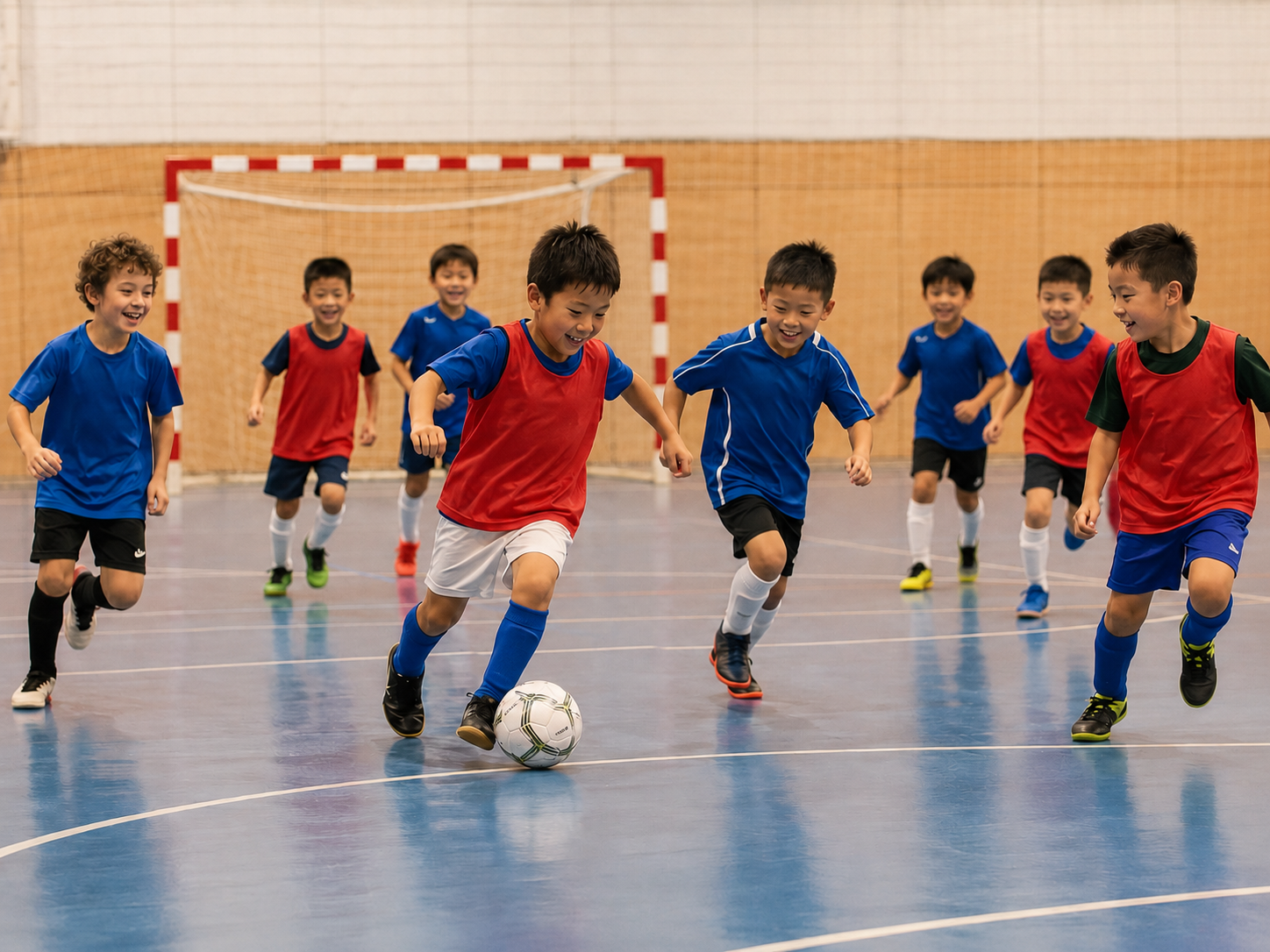
A smaller court gives every child a larger part in the game.
In futsal, creativity isn’t reserved for one player.Every player is asked to read the moment and help shape what happens next—a disguised pass, a change of pace, a run that opens space for someone else, or simply the patience to wait. Futsal doesn’t reward technique in isolation; it rewards technique used with purpose.
What experienced eyes notice
Futsal brings together spacing, movement, quick transitions, close control, shared responsibility, and creativity under pressure. These observers came to the game through soccer, and each recognized a different part of what makes it compelling.
Precision
“In a small area, the movement is necessarily fast and passes must be pinpoint.”
Legendary Dutch player and coach
Limited space gives every movement, touch, and pass greater importance.
Shared responsibility
“There are no defenders or attackers.”
One of modern soccer’s most influential coaches
Positions provide structure, but every player must understand and participate in the whole game.
Freedom
“What I love about futsal is it gives the game back to the players.”
World Cup-winning American coach
The game leaves room for players to experiment, make mistakes, and discover their own solutions.
Attention
“You have to be constantly tuned into the game.”
One of the most accomplished American soccer players
The ball remains close, possession changes quickly, and the next action is never far away.
What it felt like from within
The language changes when players describe a game they grew up with. They do not speak only about technique, tactics, or development. They remember futsal as part of childhood—played every day with friends, woven into their culture, personality, imagination, and relationship with the ball.
“As a little boy in Argentina, I played futsal. It was tremendous fun, and it really helped me become who I am today.”
“Futsal will always be my first love.”
“I played futsal every single day. It was magic.”
“We played futsal from morning to night.That was our life.”
Ricardinho’s words reveal futsal’s deeper rhythm: the player, ball, court, and moment remain in constant conversation.
Through repetition, the game doesn’t become predictable—it becomes freeing.
At full speed, patterns appear, instinct sharpens, and improvisation becomes expression. That is the tradition Mestre Zego has spent a lifetime teaching—and the experience AFF works to bring to more children.
Common Questions
Clear answers to the practical questions that often come up when someone encounters futsal for the first time.
No. Indoor soccer is often played with walls or boards that keep the ball in play, similar to hockey. Futsal has no walls—the ball goes out of bounds just like outdoor soccer, and play restarts with a kick-in. The differences in ball, court markings, and rules make futsal its own sport, not a walled-in version of another one.
The name “futsal” grew from the Spanish fútbol sala and Portuguese futebol de salão—terms for football played in a room or hall. The name reflects the game’s beginnings. In Montevideo in the 1930s, YMCA teacher Juan Carlos Ceriani developed a five-a-side game that could be played on basketball courts and in gymnasiums. He combined ideas from football, basketball, handball, and water polo, and the YMCA helped the new game spread across South America. Futsal may feel unfamiliar to many Americans today, but its earliest home was a space we already know well: the gym.
A standard AFF futsal match is played in two 20-minute halves. For the youngest age groups, match length may be shortened or otherwise adapted to suit the players’ developmental stage.
Throw-ins are replaced by kick-ins. Corners, free kicks, and goal clearances also restart the game, and many restarts must be taken within four seconds. That keeps players alert and prevents long pauses.
Players can enter and leave while the match continues, provided the substitution is made correctly through the designated area. This allows teams to preserve the game’s intensity and respond quickly as play changes.
No. There’s no offside rule in futsal, which allows players to make late attacking runs and move into open combinations without worrying about their position relative to the last defender.
Certain direct-free-kick fouls are counted for each team during a half. Beginning with the sixth, the opposing team receives a direct attempt without a defensive wall, making discipline increasingly important as the half progresses.
In futsal, the goalkeeper is not only a shot-stopper. The goalkeeper starts attacks, supports possession, and must make fast decisions under time and possession restrictions.
Not always. AFF uses FIFA’s futsal laws as the foundation, then adapts court dimensions, match structure, restart rules, goalkeeper restrictions, and other details by age. Those changes draw on guidance from a South American futsal federation, Mestre Zego’s experience and coaching philosophy, and AFF’s direct youth futsal experience. The goal is to protect futsal’s identity while serving how children actually develop—keeping players involved, asking them to make decisions, and preserving creativity and responsibility. The laws serve the child first while still teaching the real game.
Futsal is growing across the U.S. through club programs, school partnerships, and youth development initiatives. AFF is building school and community opportunities in the Orlando area. If you want futsal at a school or community space, contact us and help make the first local connection.
Ready to create a place to play where you live?
Learn How to Bring Futsal to Your CommunityOnce people understand the game, we hear the same response again and again.
Yes, We Love Futsal!®